
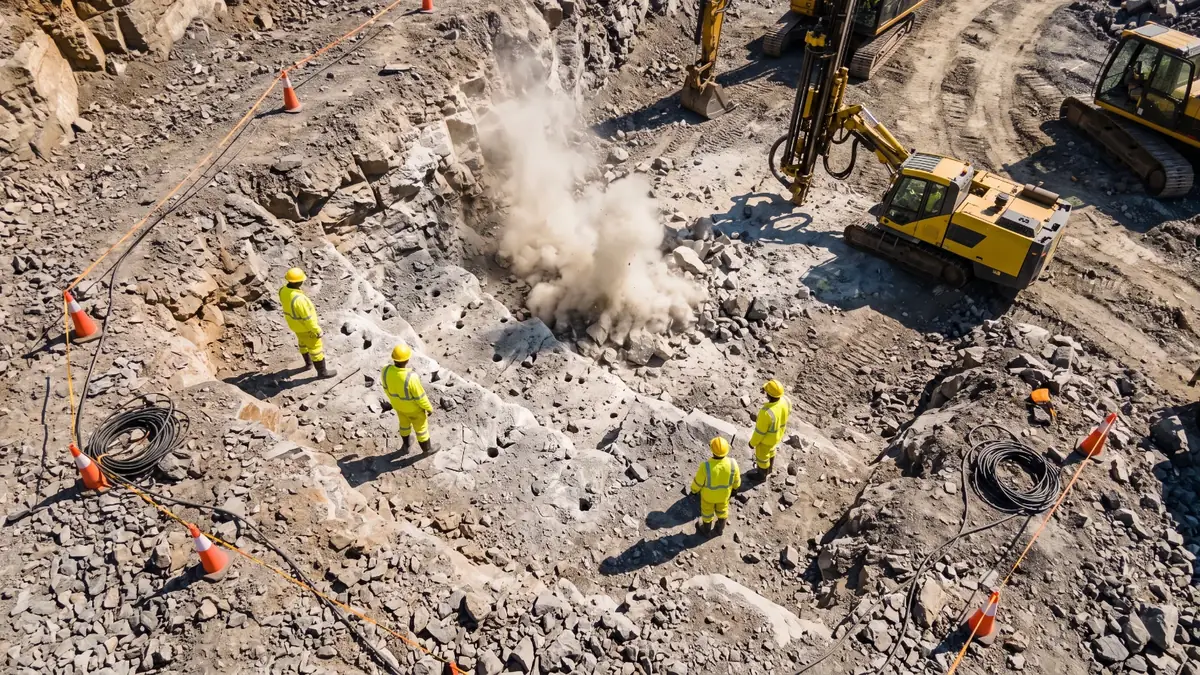
Where is the job?
Rock Blasting helps you find the best quote, fast, on rock blasting, breaking and excavation across South Africa. Describe the job once - how much rock, where it is and what stands next to it - and contractors who cover your area reply with prices you can line up side by side.
Super easy & fast
- One brief instead of five site visits, so you are not repeating yourself.
- Blasting contractors who work in your province, not a national call centre.
- Ballpark figures below, so you can tell a fair quote from a hopeful one.
- From LEADERR APPROVED providers, vetted and backed by many verified 5-star reviews. Peace of mind that the crew holds the certificates the work needs.
- No charge to you, and no obligation to accept any of the quotes.
Describe the job once and get the best quote, fast.
Get the Best QuoteRock Blasting and Breaking Prices in South Africa
Ballpark ranges across the common jobs, so you can check a quotation.
| Item | Ballpark price |
|---|---|
| Drill and blast, per cubic metre, open site | R180 - R420 |
| Drill and blast, per cubic metre, near structures | R450 - R1,100 |
| Bulk blasting, per cubic metre, over 5,000m3 | R120 - R280 |
| Quarry blasting, per tonne of crusher feed | R28 - R75 |
| Rock breaking, excavator and hammer, per hour | R850 - R2,800 |
| Rock breaking, per cubic metre, hard rock | R600 - R1,400 |
| Hydraulic rock splitting, per cubic metre | R900 - R2,500 |
| Chemical rock breaking, per cubic metre | R1,200 - R3,500 |
| Concrete breaking, per cubic metre, reinforced | R750 - R1,900 |
| Trench blasting, per linear metre, 600mm by 1m | R450 - R1,200 |
| Pile cropping, per pile, 600 to 900mm | R1,100 - R2,800 |
| Vibration monitoring, per seismograph per day | R4,500 - R15,000 |
| Pre-blast condition survey, per structure | R350 - R900 |
| Mobilisation, rig and compressor, within a metro | R8,000 - R25,000 |
Prices JUST UPDATED. Ballpark figures, rounded, excluding VAT. They reflect typical South African rock blasting, breaking and excavation rates. They are not our prices or quotations, and no provider is bound by them.
What Providers Quote For
| Job | Typical scope |
|---|---|
| Rock blasting | Drilling and firing a pattern to break rock a machine cannot dig. |
| Controlled blasting | Small charges beside houses, walls and services, measured on every blast. |
| Drill and blast contracts | The whole operation from one contractor, measured on rock broken. |
| Rock and concrete breaking | Hammers, splitters and expanding grout where explosives are out. |
| Trenches and road cuttings | Narrow rock lines for services, and cuttings under live traffic. |
| Basements and quarries | Below ground work between neighbours, and production feed for a crusher. |
| Design, survey and monitoring | The professional work bought around a blast rather than the blast. |
How Rock Jobs Are Priced
- By the cubic metre. The usual basis for blasting and breaking, measured in the ground rather than loose.
- By the tonne. Used on quarry work, because it matches what the plant produces.
- By the hour. Normal for an excavator and hammer, which puts the production risk on you.
- By the pile or the metre run. Used for pile cropping and for trenches, where the unit is obvious.
- Plus mobilisation. A fixed charge to get the plant onto site, and the item that decides small jobs.
Blasting or Breaking: Which You Need
- Large volumes favour blasting. Above a few hundred cubic metres it is usually far cheaper and faster.
- Small volumes favour a hammer. No permits, no exclusion zone and no pre-blast survey to arrange.
- Tight neighbours favour splitting or grout. No vibration at all, at several times the rate a cubic metre.
- Permanent faces favour pre splitting. A face that has to stand for years is worth cutting cleanly once.
- Ask for both. A contractor who quotes only the method they own is answering a different question.
What Blasting Contractors Must Hold
- A blasting certificate. Held personally by the person in charge of the blast, with an expiry date.
- Explosives permits. Acquiring, transporting, storing and using explosives is permitted work.
- Public liability cover. And it should name blasting rather than general construction.
- A method statement and risk assessment. For the site, not a generic document with your address typed in.
- Records of every blast. Designs, charge sheets and any monitoring traces.
Get prices for your own setup rather than a range.
Get the Best QuoteWhat to Include in Your Request
- The address. Suburb and town, so a contractor knows whether they work there.
- How much rock there is. Length, width and depth, even roughly. It drives every rate.
- What stands nearest. The closest house, wall, pipeline or power line, and how far away.
- What the rock is. Any geotechnical report, borehole log or nearby outcrop you know of.
- Access. Gate width, ground conditions and how close a truck can get.
- Whether you want it removed. Breaking only, or breaking plus load and cart away.
Before You Accept a Quote
- Check the method is stated. Blasting, breaking, splitting or grout. They are not interchangeable prices.
- Check the measurement basis. In situ or loose. The difference is about half again.
- Check what is excluded. Cart away, oversize breaking and traffic accommodation are the usual ones.
- Check the pre-blast survey. If anything stands within range, it belongs in the scope.
- Check the standing time rate. Plant waiting on a site you control is billed, so agree it upfront.
Where This Work Is Needed Most
- Sloping stands with shallow rock. Most basement and platform blasting starts here.
- Services through rock. Water, sewer, power and fibre routes where a trench will not dig.
- Road cuttings and widenings. Usually with traffic running past, which changes everything.
- Quarries and borrow pits. Production work measured in cost per tonne through the crusher.
- Demolition and alterations. Footings, slabs and bases that have to come out of a standing structure.
Frequently Asked Questions
How much does rock blasting cost in South Africa?
For an open site, roughly R180 to R420 a cubic metre of rock in the ground, plus mobilisation. Where the blast has to be cut down and covered because of neighbours, R450 to R1,100 is more usual. Volume and what stands nearby move it more than anything else.
Is it cheaper to blast rock or break it with a machine?
Below about a hundred cubic metres, breaking usually wins because blasting carries mobilisation, permits and a pre-blast survey. Above a few hundred cubic metres of hard rock, blasting is normally much cheaper and considerably faster.
Do I need a permit to blast on my own property?
You do not hold it personally, but the contractor does. Explosives are acquired, transported, stored and used under the Explosives Act 15 of 2003, and the blast is fired by a person holding a current blasting certificate. Some municipalities attach conditions of their own, so check with yours.
Can rock be removed without blasting?
Yes. Hydraulic hammers, wedge splitters and expanding grout all break rock without a detonation, which is why they are used in basements, beside heritage structures and where no permit will be granted. They cost several times more a cubic metre and work much more slowly.
Will blasting damage the houses next door?
A properly designed blast stays well below the level at which cosmetic damage starts. What protects everyone is a pre-blast condition survey, which photographs and dates the existing cracks before work starts, and a seismograph record for every blast.
Who sets the vibration limit?
The project engineer or the client specification, rather than one national figure. It depends on what the nearby structure is and what condition it is in. Where a municipality attaches its own condition, that applies as well, so check with your council.
How long does a rock job take?
The permits and the condition survey usually take longer than the work. Once plant is on site, a few hundred cubic metres is commonly drilled and fired within a week. A hammer on the same volume of hard rock can take several times that.
What happens to the broken rock?
It is left on site, stockpiled, used as fill or carted away, and those are four different prices. On a basement everything has to leave, which is why cart away matters most there. On an earthmoving site, blasted rock often becomes fill and saves twice.
Is there a charge for using this site?
No. Send the job details once and the contractors who cover your area reply with their own prices. You are not committed to any of them and nothing is charged to you for the introduction.
Rock Blasting and Breaking in South Africa
Choose the work you need quoted
Blasting and Rock Removal
Rock Blasting
Drilling and firing a pattern to break rock a machine cannot dig.
Bulk Blasting
Thousands of cubic metres worked in benches, priced on production.
Quarry Blasting
Production blasting designed around the crusher behind it.
Controlled Blasting
Small charges beside houses and walls, measured on every blast.
Drilling and Blasting
The whole operation from one contractor, measured on rock broken.
Trenches, Roads and Basements
Trench Blasting
Narrow rock lines for water, sewer, power and fibre routes.
Roadworks Blasting
Cuttings and widenings, usually with traffic still running past.
Bulk Excavation
Site platforms and bulk earthmoving, with the rock priced before it is found.
Basement Blasting
Below ground rock on a stand that is surrounded on every side.
Underwater Blasting
Berths, channels and crossings cut below the waterline.
Breaking Without Explosives
Rock Breaking
Excavator mounted hammers where a blast is not practical.
Chemical Rock Breaking
Expanding grout that splits rock with no detonation and no permit.
Rock Splitting
Hydraulic wedges for silent work in confined and sensitive places.
Concrete Breaking
Slabs, footings and structures, with the method set by the steel.
Pile Capping
Piles cropped to cut off level with the reinforcement left clean.
Hand Drilling
Hand held work where no rig can stand and no machine can reach.
Design and Monitoring
Blast Design
Burden, spacing, depth and delays, signed by a competent person.
Vibration Monitoring
Seismographs on the neighbours, with a trace issued per blast.
Get the Best Quote, Fast
Client Reviews
Powered by leaderr
